BACK TO PROJECTS

Purdue Galleries

Purdue Galleries

Creating a Unique Digital Identity for the Galleries

INTERNSHIP

CMS
Context

Internship

Role

UX Designer, Lead Programmer

Skills

UX Research, Co-Design, CMS

Duration

Feb - June 2025

THE PROBLEM

The Galleries' website is confusing and doesn't attract users.

The Purdue Galleries website, a key resource for accessing information to important arts events in the area, is difficult to navigate and lacks essential usability features, making it challenging for users to find relevant details. This results in missed opportunities for engagement and connection within the arts community.

My team's goal was to redesign the website to improve usability, accessibility, and overall engagement. By creating a more intuitive and visually appealing platform, we aimed to bridge the gap between interested students and the arts scene at Purdue, ultimately increasing participation and support for campus galleries.

THE SOLUTION

A website redesign focused on turning confusion into intuitive navigation.
SCROLL TO SEE FULL SOLUTION

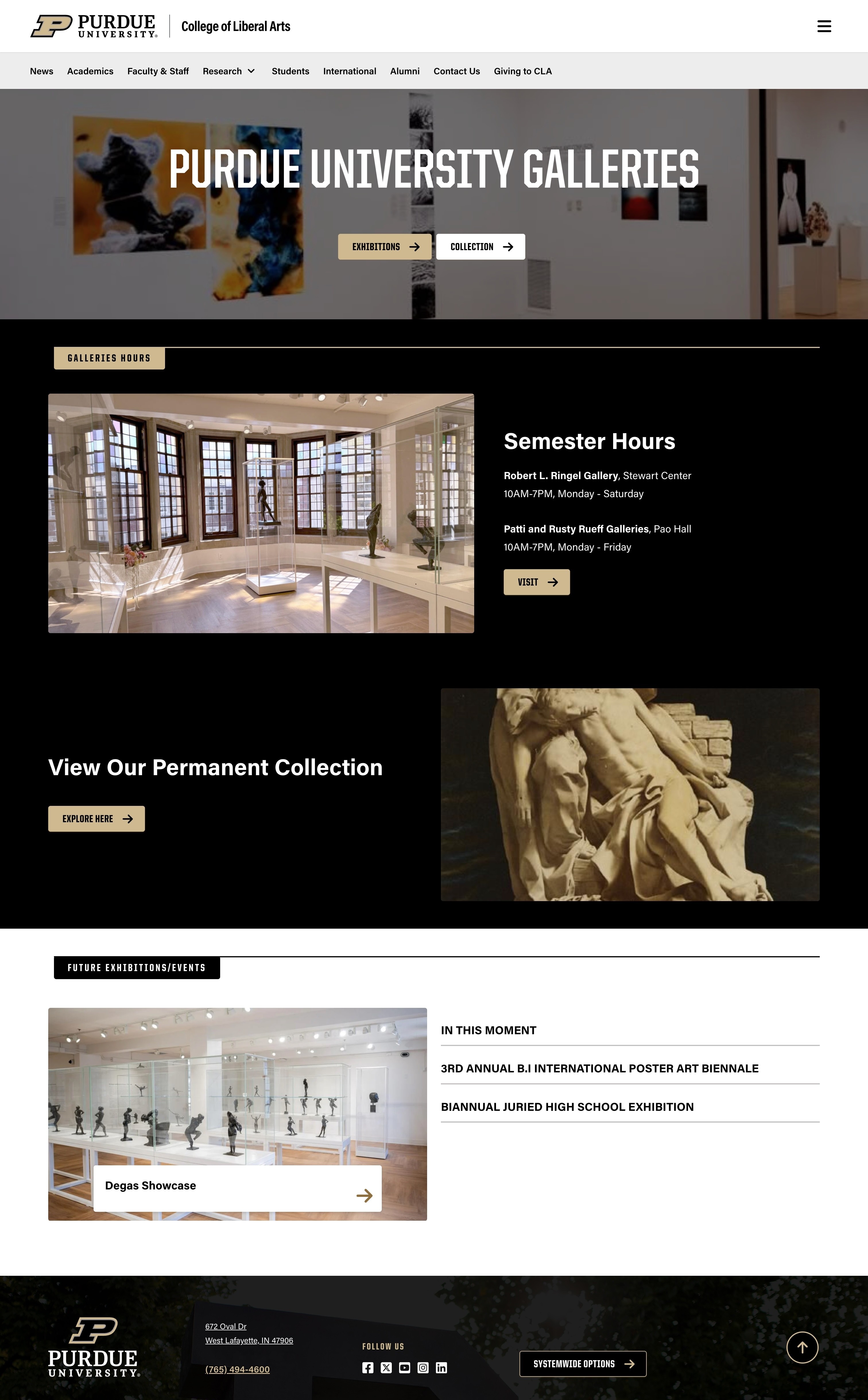
This is the new homepage for the Purdue Galleries' website. It features a hero image that is clear in representing the Galleries' identity. The rest of the sections reflect a specific hierarchy of importance, and guide users to recommended sections. This page was built in Purdue's Content Management Software.

The Process

01 BACKGROUND

Prior to the Internship
During my second year at Purdue, my team and I completed a class project focused on improving the Purdue Galleries website. The goal was to apply specific research methods and front-end programming skills using HTML and CSS.

Before moving into design and development, we conducted interviews, usability testing of the existing site, and co-design sessions with Purdue students in our target audience. These methods gave us valuable insights into how users perceived and interacted with the current website.


During my second year at Purdue, my team and I completed a class project focused on improving the Purdue Galleries website. The goal was to apply specific research methods and front-end programming skills using HTML and CSS.

Before moving into design and development, we conducted interviews, usability testing of the existing site, and co-design sessions with Purdue students in our target audience. These methods gave us valuable insights into how users perceived and interacted with the current website.


During my second year at Purdue, my team and I completed a class project focused on improving the Purdue Galleries website. The goal was to apply specific research methods and front-end programming skills using HTML and CSS.

Before moving into design and development, we conducted interviews, usability testing of the existing site, and co-design sessions with Purdue students in our target audience. These methods gave us valuable insights into how users perceived and interacted with the current website.


Key Findings

Our research revealed that the primary issue with the website was a lack of clear hierarchy and structure. Students frequently struggled to locate information, leading to frustration during testing.

Additionally, since many users were art and design students, they felt disconnected from the website’s visual style, which followed the standard Purdue template rather than reflecting the creative identity of the Galleries.

These insights informed the creation of our primary user persona, shown below, which guided our design decisions moving forward.

USER PERSONA:

Key Findings

Our research revealed that the primary issue with the website was a lack of clear hierarchy and structure. Students frequently struggled to locate information, leading to frustration during testing.

Additionally, since many users were art and design students, they felt disconnected from the website’s visual style, which followed the standard Purdue template rather than reflecting the creative identity of the Galleries.

These insights informed the creation of our primary user persona, shown below, which guided our design decisions moving forward.

"Dave was walking in the Stewart Center, when he stumbled across the Robert L Ringle gallery. He decided to explore what the gallery had to offer. He really enjoyed the exhibition but, when he went to the Purdue Galleries website to learn more about upcoming exhibitions, he struggled to find information about their upcoming events and new exhibitions as they were difficult to locate on the website and were presented in a poor manner. Dave left the site feeling frustrated."

INITIAL DESIGN

My initial design for the landing page is shown here. Currently, Purdue Galleries does not have a true landing page, which often leaves visitors unsure of where to start. I designed a dedicated landing page that aligns with Purdue’s branding guidelines while reflecting the unique identity of the Galleries. The layout emphasizes clarity and focuses on the most important information, helping users quickly find what they’re looking for.

My initial design for the landing page is shown here. Currently, Purdue Galleries does not have a true landing page, which often leaves visitors unsure of where to start. I designed a dedicated landing page that aligns with Purdue’s branding guidelines while reflecting the unique identity of the Galleries. The layout emphasizes clarity and focuses on the most important information, helping users quickly find what they’re looking for.

My initial design for the landing page is shown here. Currently, Purdue Galleries does not have a true landing page, which often leaves visitors unsure of where to start. I designed a dedicated landing page that aligns with Purdue’s branding guidelines while reflecting the unique identity of the Galleries. The layout emphasizes clarity and focuses on the most important information, helping users quickly find what they’re looking for.


TRANSITION

After completing this project, including my team’s additional pages, we presented our work to the Head of Galleries (HG). She was impressed with our designs and invited us to continue the project as interns, implementing the new site within Purdue’s CMS, Cascade. We officially began our internship in February.


After completing this project, including my team’s additional pages, we presented our work to the Head of Galleries (HG). She was impressed with our designs and invited us to continue the project as interns, implementing the new site within Purdue’s CMS, Cascade. We officially began our internship in February.


After completing this project, including my team’s additional pages, we presented our work to the Head of Galleries (HG). She was impressed with our designs and invited us to continue the project as interns, implementing the new site within Purdue’s CMS, Cascade. We officially began our internship in February.


02 ADDITIONAL RESEARCH

Internship Introduction

To officially begin our internship, we did some additional research to ensure our designs best addressed user problems. We did this through:

  • A Literature Review, where we considered scholarly articles about the problems art galleries are facing and how they can better attract visitors.

  • A Comparative Analysis of similar gallery websites.

Key Findings

Through this research, we saw proof of a need for a strong brand identity among the website. We also saw that clear use of buttons, rather than hyperlinks, is vital to success in navigation.

To officially begin our internship, we did some additional research to ensure our designs best addressed user problems. We did this through:

  • A Literature Review, where we considered scholarly articles about the problems art galleries are facing and how they can better attract visitors.

  • A Comparative Analysis of similar gallery websites.

Key Findings

Through this research, we saw proof of a need for a strong brand identity among the website. We also saw that clear use of buttons, rather than hyperlinks, is vital to success in navigation.

To officially begin our internship, we did some additional research to ensure our designs best addressed user problems. We did this through:

  • A Literature Review, where we considered scholarly articles about the problems art galleries are facing and how they can better attract visitors.

  • A Comparative Analysis of similar gallery websites.

Key Findings

Through this research, we saw proof of a need for a strong brand identity among the website. We also saw that clear use of buttons, rather than hyperlinks, is vital to success in navigation.

03 ITERATION

Designing for Cascade

Our Assignment

At the start of our internship, our sponsor connected us with the College of Liberal Arts (CLA) web developer, who had been creating new templates within Purdue’s CMS, Cascade. He asked our team to actively review these templates as part of our design and implementation work.

As a result, alongside designing, we were also responsible for evaluating the platform and its templates for best practices. This became an important part of our workflow, as Cascade had several limitations that directly influenced our design decisions. Working closely with the developer not only supported our process but also allowed us to contribute to Purdue’s broader web development efforts.

Onboarding

I led the Cascade onboarding for our team. We received training materials in the form of videos and documentation, and I worked through each resource in detail to identify the platform’s initial challenges. I then guided my teammates through the system, helping them understand how to work within Cascade’s constraints. This foundational work was crucial, as none of us had previously used a CMS like Cascade.

Our Assignment

At the start of our internship, our sponsor connected us with the College of Liberal Arts (CLA) web developer, who had been creating new templates within Purdue’s CMS, Cascade. He asked our team to actively review these templates as part of our design and implementation work.

As a result, alongside designing, we were also responsible for evaluating the platform and its templates for best practices. This became an important part of our workflow, as Cascade had several limitations that directly influenced our design decisions. Working closely with the developer not only supported our process but also allowed us to contribute to Purdue’s broader web development efforts.

Onboarding

I led the Cascade onboarding for our team. We received training materials in the form of videos and documentation, and I worked through each resource in detail to identify the platform’s initial challenges. I then guided my teammates through the system, helping them understand how to work within Cascade’s constraints. This foundational work was crucial, as none of us had previously used a CMS like Cascade.

Our Assignment

At the start of our internship, our sponsor connected us with the College of Liberal Arts (CLA) web developer, who had been creating new templates within Purdue’s CMS, Cascade. He asked our team to actively review these templates as part of our design and implementation work.

As a result, alongside designing, we were also responsible for evaluating the platform and its templates for best practices. This became an important part of our workflow, as Cascade had several limitations that directly influenced our design decisions. Working closely with the developer not only supported our process but also allowed us to contribute to Purdue’s broader web development efforts.

Onboarding

I led the Cascade onboarding for our team. We received training materials in the form of videos and documentation, and I worked through each resource in detail to identify the platform’s initial challenges. I then guided my teammates through the system, helping them understand how to work within Cascade’s constraints. This foundational work was crucial, as none of us had previously used a CMS like Cascade.

DESIGN ITERATION

Once we gained a stronger understanding of Cascade, we began transitioning our designs into the available templates. As mentioned earlier, both Cascade and the templates had several limitations, which required extensive problem-solving. Our team made thoughtful adjustments to our designs to ensure they aligned with the platform’s constraints and Purdue’s branding guidelines.

Throughout this iteration phase, we focused on preserving the integrity of our original design decisions, such as hierarchy, grouping, and key content structures, as these choices were grounded in research and directly addressed user needs.

Once we gained a stronger understanding of Cascade, we began transitioning our designs into the available templates. As mentioned earlier, both Cascade and the templates had several limitations, which required extensive problem-solving. Our team made thoughtful adjustments to our designs to ensure they aligned with the platform’s constraints and Purdue’s branding guidelines.

Throughout this iteration phase, we focused on preserving the integrity of our original design decisions, such as hierarchy, grouping, and key content structures, as these choices were grounded in research and directly addressed user needs.

Once we gained a stronger understanding of Cascade, we began transitioning our designs into the available templates. As mentioned earlier, both Cascade and the templates had several limitations, which required extensive problem-solving. Our team made thoughtful adjustments to our designs to ensure they aligned with the platform’s constraints and Purdue’s branding guidelines.

Throughout this iteration phase, we focused on preserving the integrity of our original design decisions, such as hierarchy, grouping, and key content structures, as these choices were grounded in research and directly addressed user needs.

04 HANDOFF

Testing & Finalization

While finalizing my design, I conducted three brief rounds of A/B testing to validate, and occasionally challenge, my design decisions. This helped me quickly gather targeted user feedback on the updated designs.

After iterating based on the insights I received, I prepared a full handoff for the CLA web developer and the Head of Galleries for final validation. Along with the design files, I created a documentation guide outlining how to update and maintain the site moving forward. Since the Head of Galleries currently updates the website on a monthly basis, she noted that this resource would be extremely helpful in streamlining her workflow.

While finalizing my design, I conducted three brief rounds of A/B testing to validate, and occasionally challenge, my design decisions. This helped me quickly gather targeted user feedback on the updated designs.

After iterating based on the insights I received, I prepared a full handoff for the CLA web developer and the Head of Galleries for final validation. Along with the design files, I created a documentation guide outlining how to update and maintain the site moving forward. Since the Head of Galleries currently updates the website on a monthly basis, she noted that this resource would be extremely helpful in streamlining her workflow.

While finalizing my design, I conducted three brief rounds of A/B testing to validate, and occasionally challenge, my design decisions. This helped me quickly gather targeted user feedback on the updated designs.

After iterating based on the insights I received, I prepared a full handoff for the CLA web developer and the Head of Galleries for final validation. Along with the design files, I created a documentation guide outlining how to update and maintain the site moving forward. Since the Head of Galleries currently updates the website on a monthly basis, she noted that this resource would be extremely helpful in streamlining her workflow.

MY CONTRIBUTIONS

Research, Landing Page, & CMS/Programming Assistance

Research

I assisted in conducting user interviews and took the lead on facilitating the co-design sessions. These activities provided valuable insights into how students felt while navigating the website and revealed key pain points in their experience.

Landing Page

I was responsible for designing the entire landing page from start to finish. The process began with wireframing and evolved through iterative design refinements. The final version is now fully built in the CMS platform and ready for implementation.

CMS Onboarding Lead

Purdue was collaborating with the platform used to build the website to develop new content templates. Our team needed to learn this platform in order to transfer our designs effectively. During this process, I took the lead in learning the system and helped my teammates understand its features and workflows, ensuring our designs were implemented accurately and efficiently.

CONTACT ME

Let's Work Together

CONTACT ME

Let's Work Together

Create a free website with Framer, the website builder loved by startups, designers and agencies.